

23 Heuchera Front Yard Ideas That Transform Instantly
Heuchera, also called coral bells, is grown mainly for its leaves, which come in near-black, purple, lime, amber, silver and rose. It forms low mounds, stays semi-evergreen to evergreen depending on the climate, and NC State Extension lists it as deer and rabbit resistant, so it makes a dependable edging and ground layer for front yards.
Below are 23 ways to use heuchera in a front yard, with the details that decide whether it thrives. Start with the basics, because light and drainage matter more than leaf color.
Heuchera basics
Light
Most heucheras do best in partial or dappled shade. Dark-leaved types such as ‘Palace Purple’ and ‘Obsidian’ handle more sun, while lime, gold and amber leaves tend to scorch in hot afternoon sun.
Drainage
Heuchera wants moist but well-drained soil rich in organic matter. Soggy ground rots the crown, and the plant dislikes heavy clay, so work in compost or grow it in raised beds or containers.
Hardiness and heat
NC State Extension lists heuchera for USDA zones 3 to 9, though most named cultivars are rated for zones 4 to 8 or 4 to 9. Hairy alumroot (Heuchera villosa) and hybrids with villosa parentage, such as ‘Citronelle’, handle hot, humid summers better than most.
Spacing and renewal
Space plants by the mature width on the tag, usually 12 to 18 inches. Plants get woody in the center, and NC State notes they are short-lived unless divided every 3 or 4 years.
The 23 ideas at a glance
| Idea | Light | Try | Watch for |
|---|---|---|---|
| Purple walkway border | Part shade to sun | ‘Obsidian’, ‘Palace Purple’ | Mounds spilling onto the path |
| Lime planting under trees | Part shade | ‘Citronelle’, ‘Lime Rickey’ | Dry soil and tree roots |
| With hostas | Part to full shade | Amber or silver types | Deer; hostas toxic to pets |
| Foundation drift | Morning sun | Three or four colors | Downspouts and drip lines |
| Silver moonlight bed | Part shade | ‘Silver Scrolls’, ‘Pewter Veil’ | Afternoon sun scorch |
| Raised bed edging | Part shade to sun | One color or warm mix | Faster drying |
| Flanking the steps | Part shade to sun | ‘Obsidian’, ‘Midnight Rose’ | Uneven plant sizes |
| Containers by the door | Part shade | Two or three colors | Daily watering in heat |
| Warm-toned ground cover | Morning sun or bright shade | ‘Caramel’, ‘Southern Comfort’ | Scorch in hot sun |
| Rock garden | Part shade | Compact types | Drying out |
| Around the mailbox | Depends on the spot | Dark types in sun | Road salt and plowed snow |
| With ornamental grasses | Sun to part shade | Dark types with ‘Karl Foerster’ | Grass flops in shade |
| Around path lights | Part shade | ‘Lime Marmalade’ | Leaves covering fixtures |
| One-cultivar modern planting | As the cultivar needs | ‘Lime Rickey’ | Gaps after losses |
| Window boxes | Part shade | Compact mounding types | Invasive trailing partners |
| Small lawn replacement | Part shade | Vigorous types | No foot traffic |
| Spiral bed | Part shade | ‘Obsidian’ with ‘Lime Rickey’ | Keeping the pattern after division |
| Around a water feature | Part shade | Any | Soil soaked by overflow |
| Color gradient | Part shade | Lime to amber to purple | Uneven vigor |
| Hypertufa troughs | Part shade | Compact types | Drainage holes |
| Under roses | Sun | Dark-leaved types | Crowding the rose canes |
| Seasonal color | Varies | ‘Southern Comfort’, ‘Green Spice’, ‘Amber Waves’ | Color varies by climate |
| Entrance planting | Varies | Three to five colors | Driveway sight lines |
1. Deep Purple Heuchera Border Along the Walkway
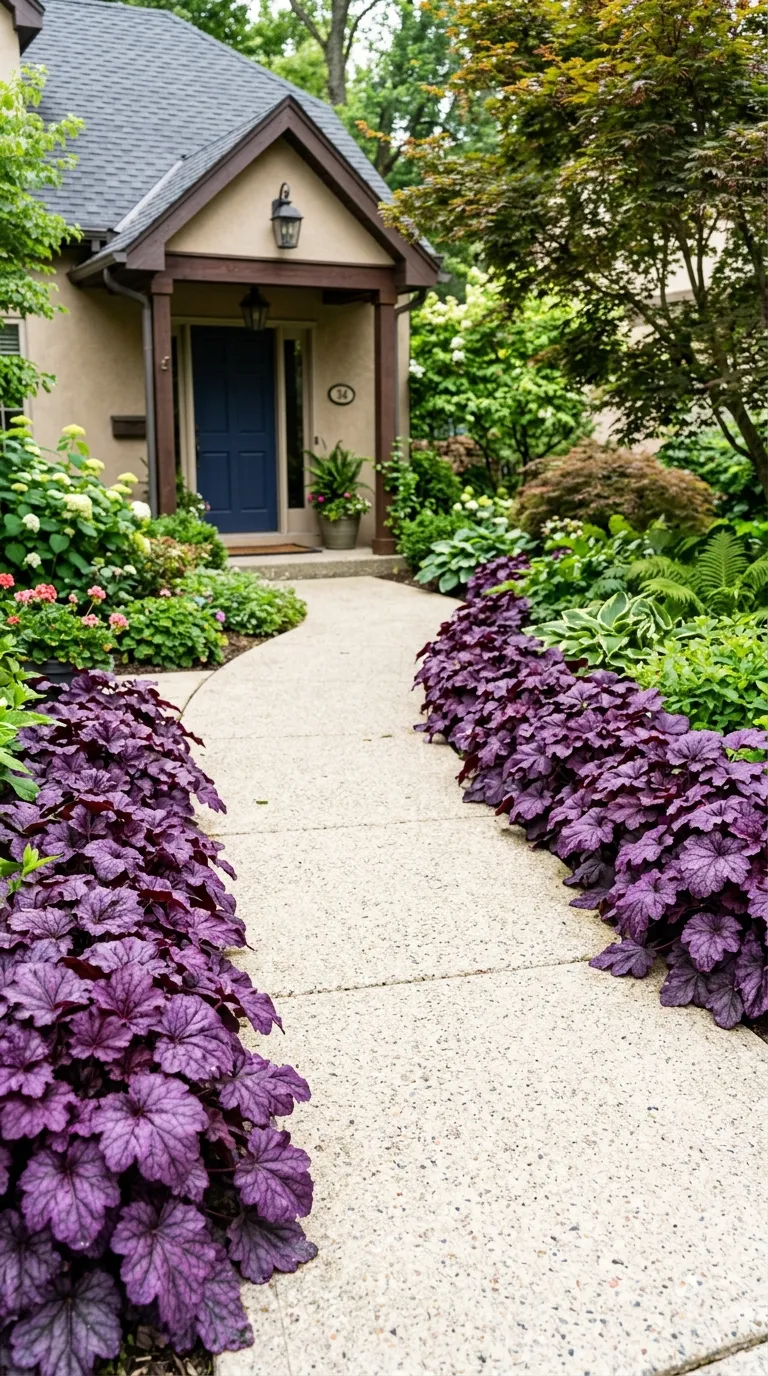
A row of dark heuchera on both sides of the front walk contrasts well with pale concrete or stone and frames the entry. ‘Obsidian’ keeps its near-black leaves through the season, according to the Missouri Botanical Garden, and forms a mound about 8 to 10 inches tall. ‘Palace Purple’ shifts from olive and bronze-green to deep purple. Set plants back from the edge so mounds don’t spill onto the path.
Good to know: space plants by the mature width on the tag (‘Obsidian’ grows about 16 inches wide); dark-leaved types like these take more sun than pale ones.
2. Lime Green Heuchera Mass Planting Under Trees
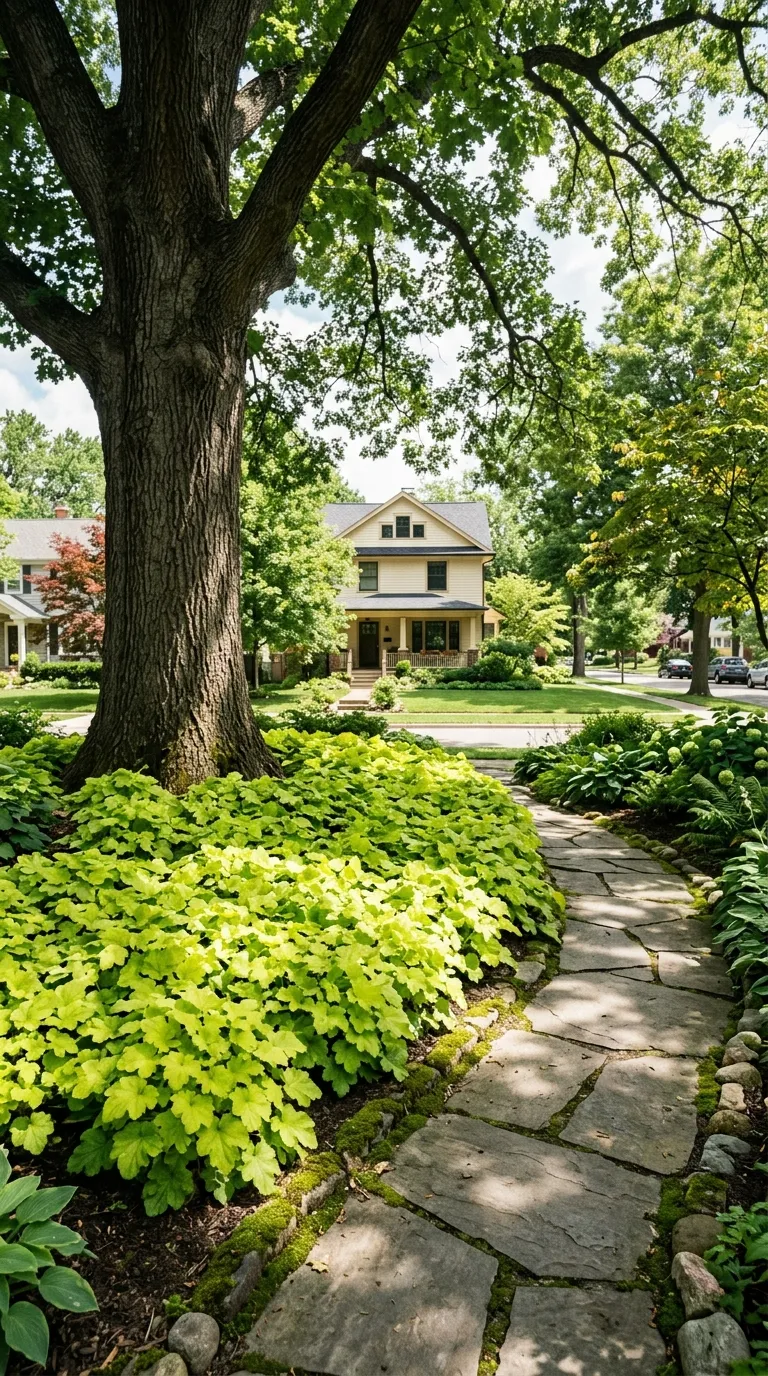
Lime and chartreuse heucheras brighten the shade under a front yard tree. ‘Citronelle’ has yellow-green leaves and, thanks to Heuchera villosa parentage, handles hot, humid summers better than most heucheras; ‘Lime Rickey’ has ruffled lime-green leaves. Plant groups of five or more of one variety for a solid sweep of color, and mulch lightly between them.
Good to know: soil under trees is often dry and full of roots, so water through the first summer, dig small holes by hand between roots, and don’t spread new soil over the root zone.
3. Heuchera and Hosta Combination for Layered Texture
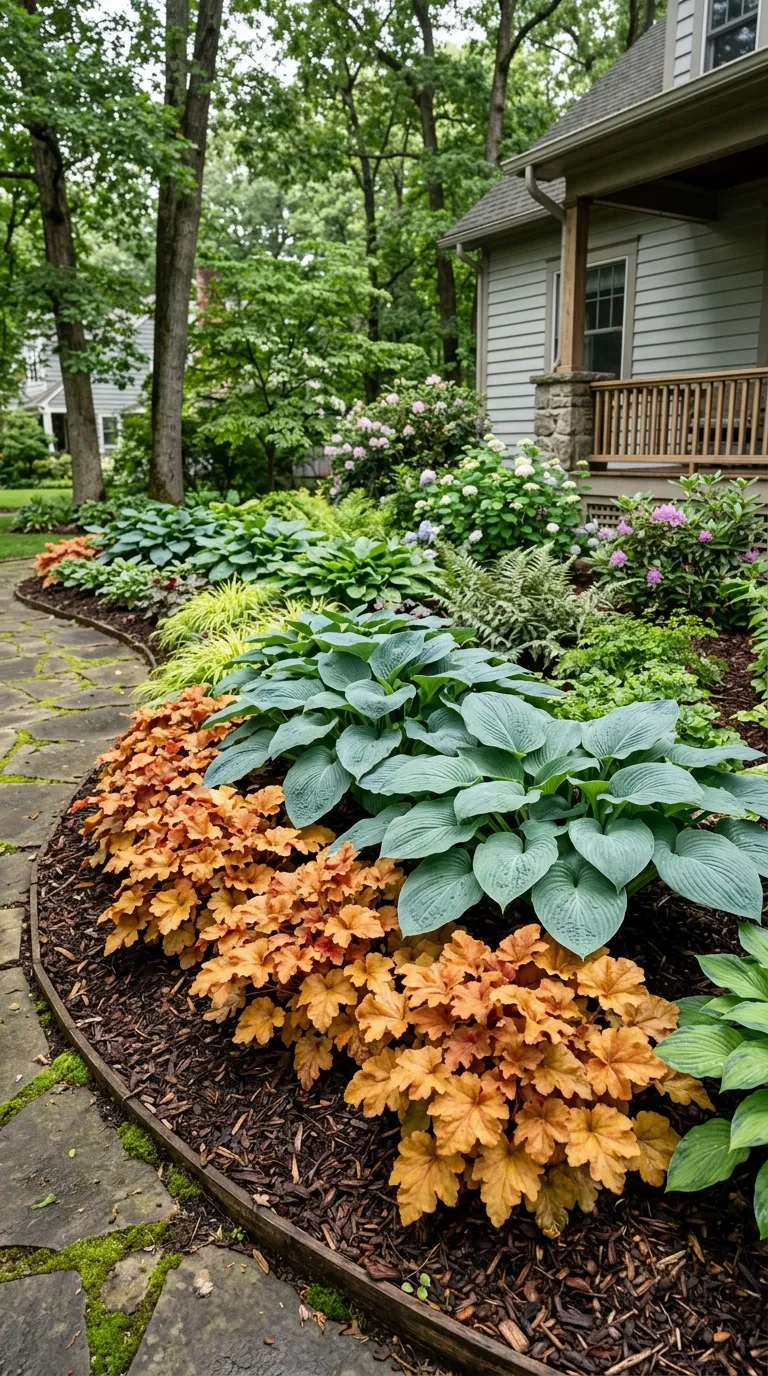
Heuchera and hosta pair well in shade: heuchera’s scalloped, colorful leaves sit in front of hosta’s broad, smooth ones. Try amber or caramel heuchera in front of blue hostas, or silver heuchera beside dark green ones. Both like moist, well-drained soil rich in organic matter, and neither tolerates soggy ground.
Good to know: NC State Extension notes that deer and rabbits eat hostas (heuchera is generally deer resistant) and that all parts of hosta are toxic to cats, dogs and horses, so consider pets and deer before planting the pair.
4. Mixed Color Heuchera Drift Along the Foundation
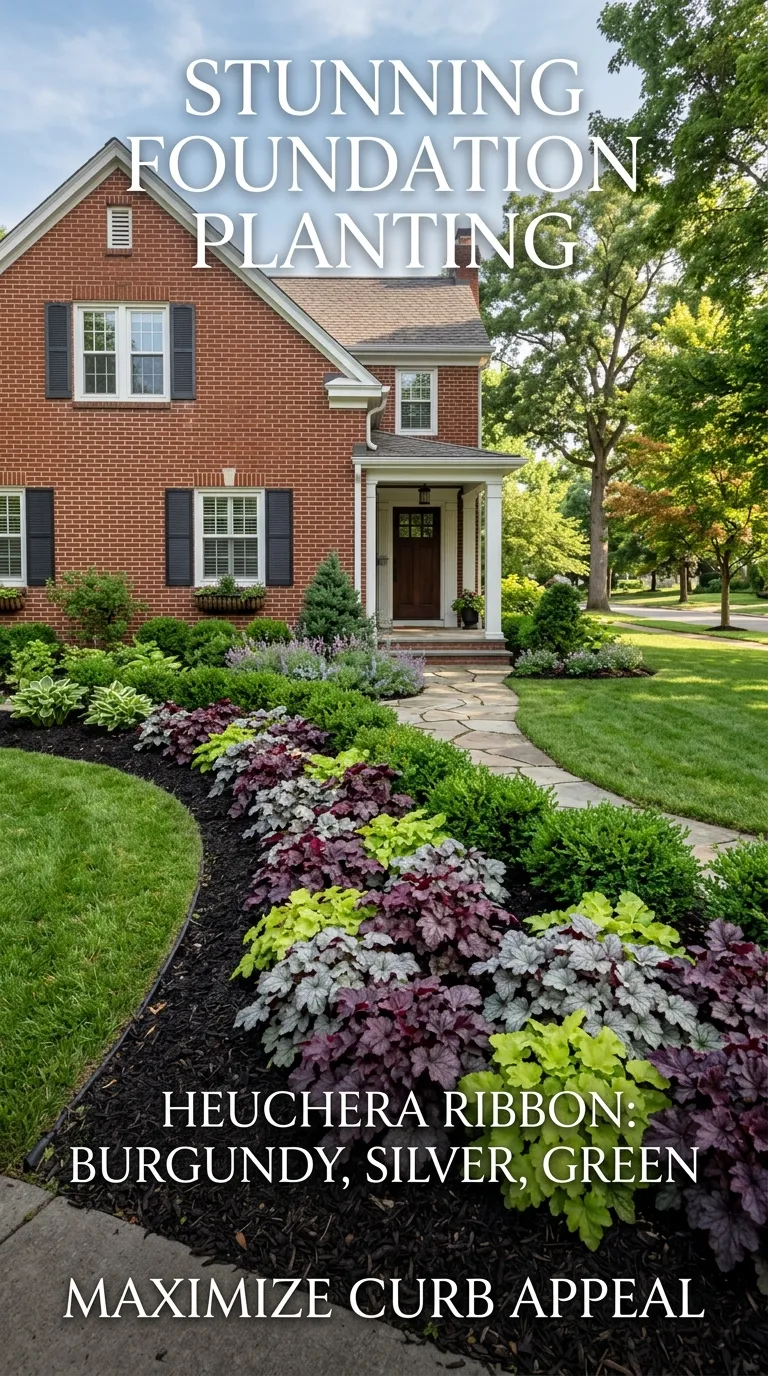
A drift of three or four heuchera colors along the house foundation softens brick or siding without blocking windows, since the foliage mounds stay low and only the flower stems rise higher. Choose colors that suit the house, such as burgundy and silver against gray siding or caramel and green against warm brick, and plant in groups of three to five of each rather than alternating single plants.
Good to know: keep heuchera out from under roof drip lines and downspouts, where constant runoff keeps the soil wet; soggy soil rots the crowns.
5. Silver Heuchera in a Moonlight Garden Bed
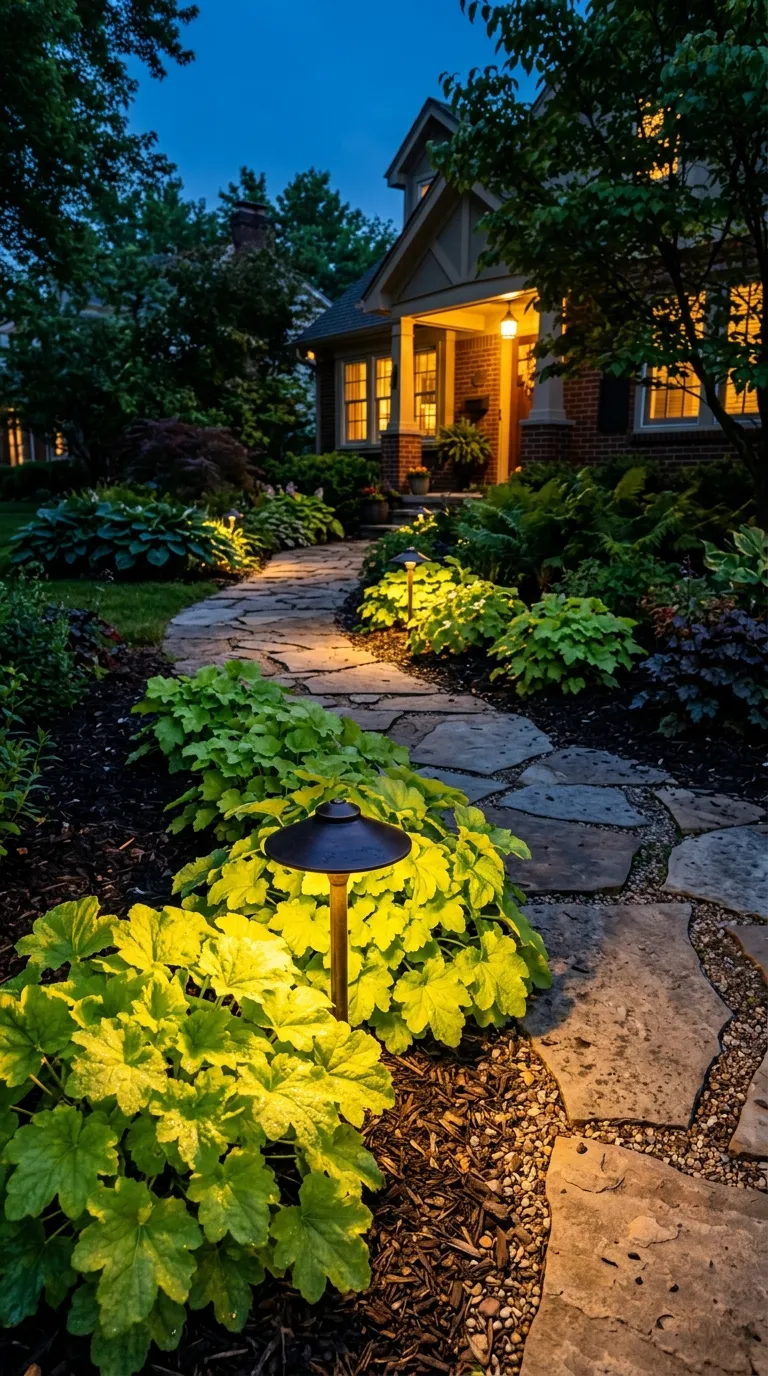
Silver-leaved heucheras reflect low light, so they show up at dusk when darker plants fade from view. ‘Silver Scrolls’ has metallic silvery-purple leaves with dark veins, and ‘Pewter Veil’ matures to metallic silver; the Missouri Botanical Garden rates both for zones 4 to 9. Pair them with white-flowered astilbe or other white shade flowers and a few low path lights.
Good to know: give silver types morning sun and afternoon shade; most heucheras prefer partial shade, and hot afternoon sun can scorch the leaves.
6. Heuchera Edging a Raised Garden Bed
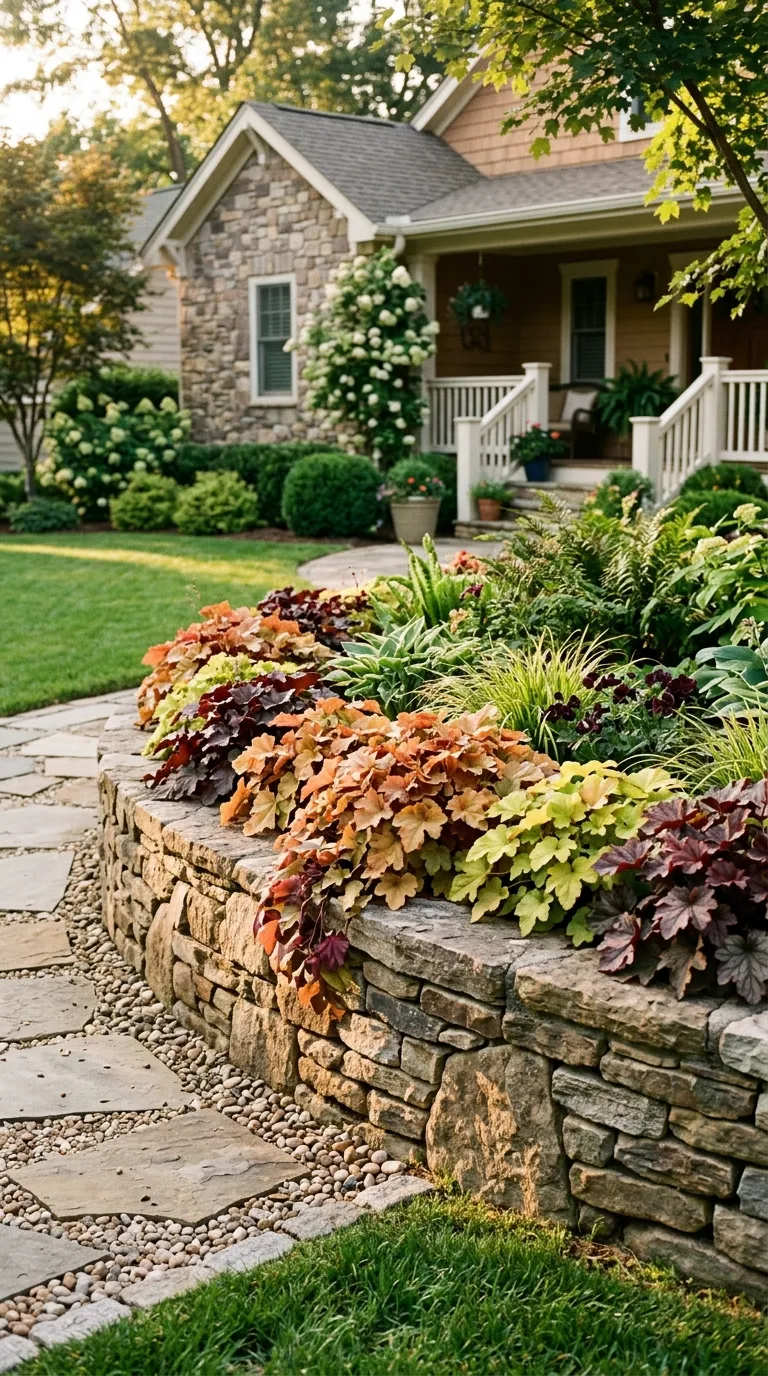
Heuchera along the front edge of a raised bed softens stone or timber walls as the mounds spill slightly over the edge. Use one color for a clean line or mix warm tones for a cottage look. Heuchera is shallow-rooted, so it suits a bed edge, and a raised bed gives it the drainage it needs; the RHS recommends raised beds or containers where garden soil stays wet.
Good to know: raised beds dry out faster than the ground, so check soil moisture often in summer, especially along the sunny side.
7. Burgundy Heuchera Flanking the Front Steps
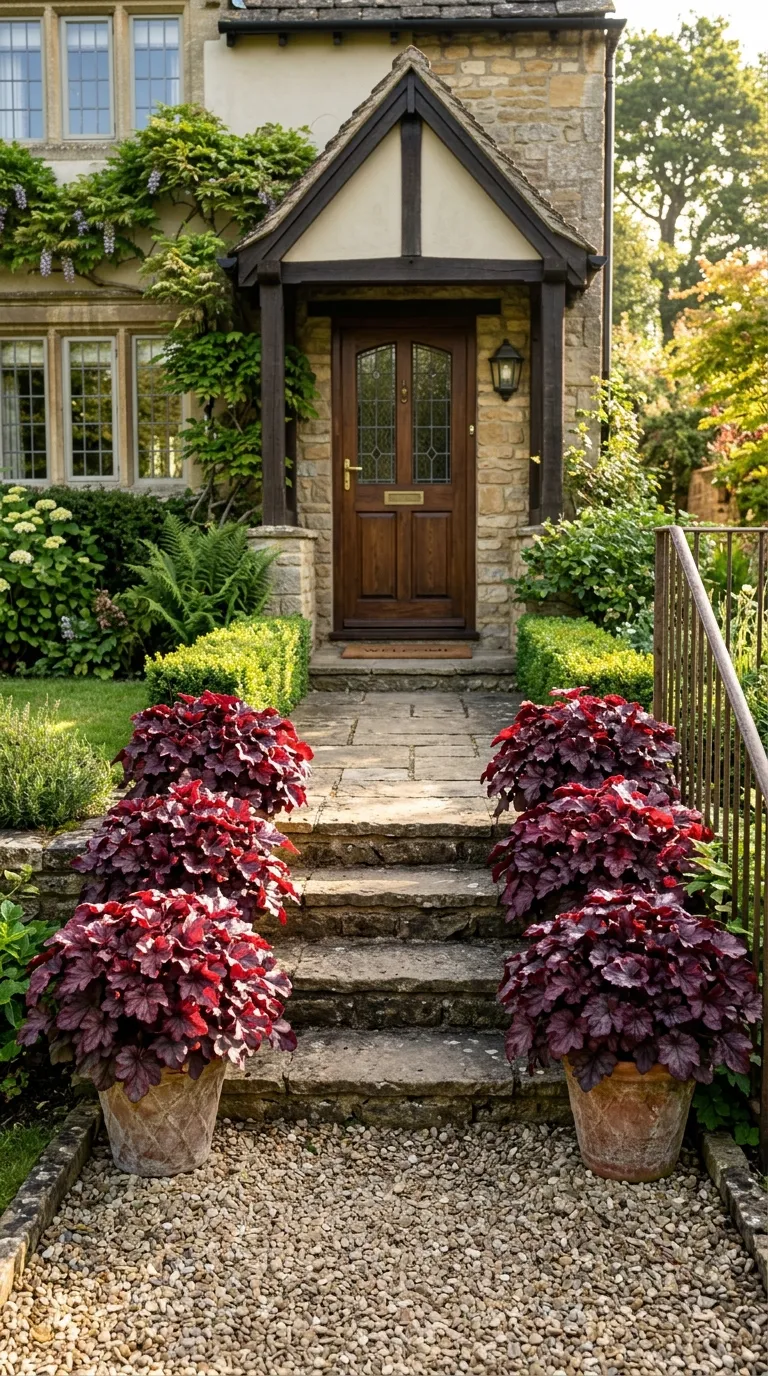
Matching groups of dark heuchera on each side of the front steps frame the entrance and balance the facade. ‘Obsidian’, or ‘Midnight Rose’, whose dark purple leaves carry hot-pink speckles that fade to cream over summer, stands out against light stone or painted steps. Keep the groups the same size for a formal look, or vary them slightly for a relaxed one.
Good to know: for a symmetrical planting, buy all the plants at the same time and size so both sides grow in evenly.
8. Heuchera Container Display by the Front Door
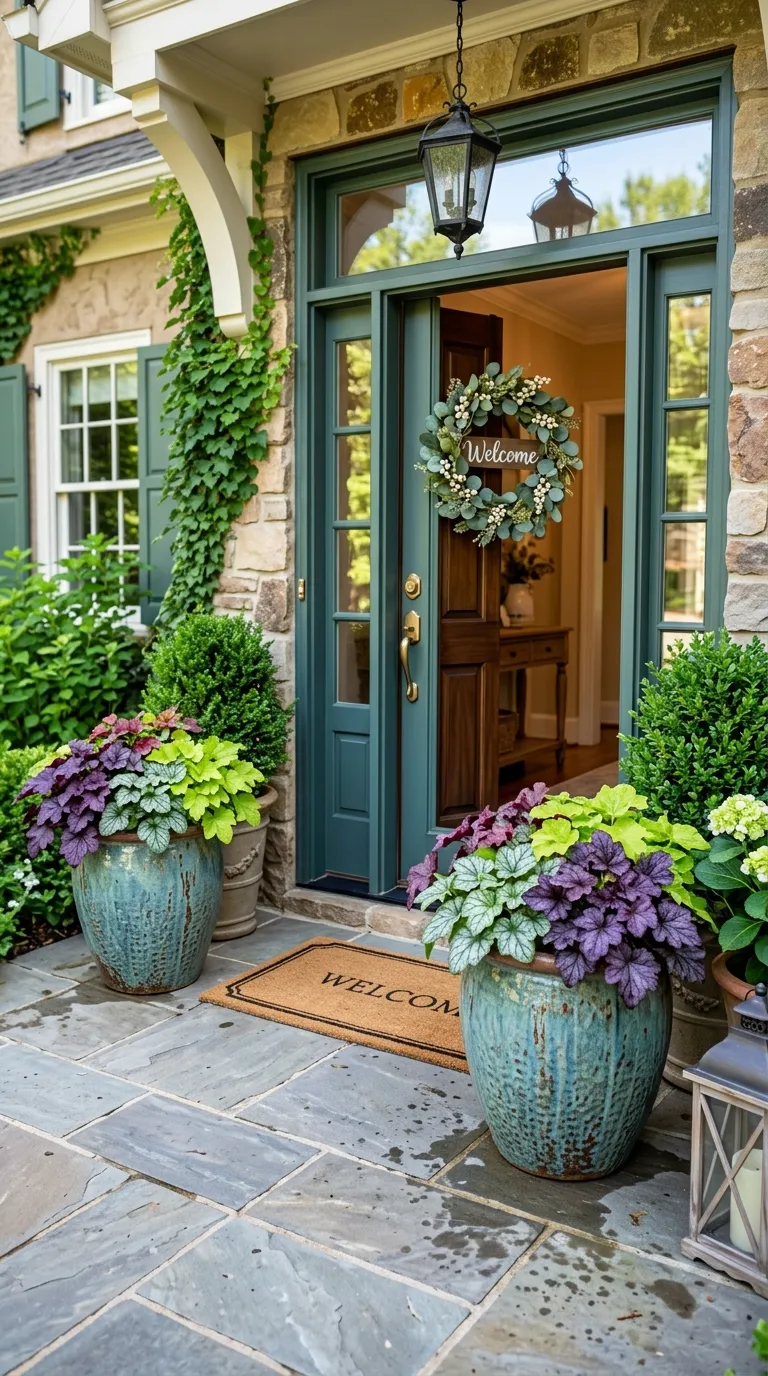
Heuchera grows well in containers, alone or with two or three colors in one large pot. Use a free-draining potting mix and a pot with drainage holes, place it where it gets shade in the afternoon, and feed with a liquid fertilizer in spring and summer, since potting mix runs out of nutrients after a few months. The plants can stay in the pot until they need dividing.
Good to know: potted heuchera dries out quickly and may need watering daily in hot weather; in winter, the RHS advises moving soggy pots to a sheltered spot out of heavy rain.
9. Caramel Heuchera as Warm Toned Ground Cover
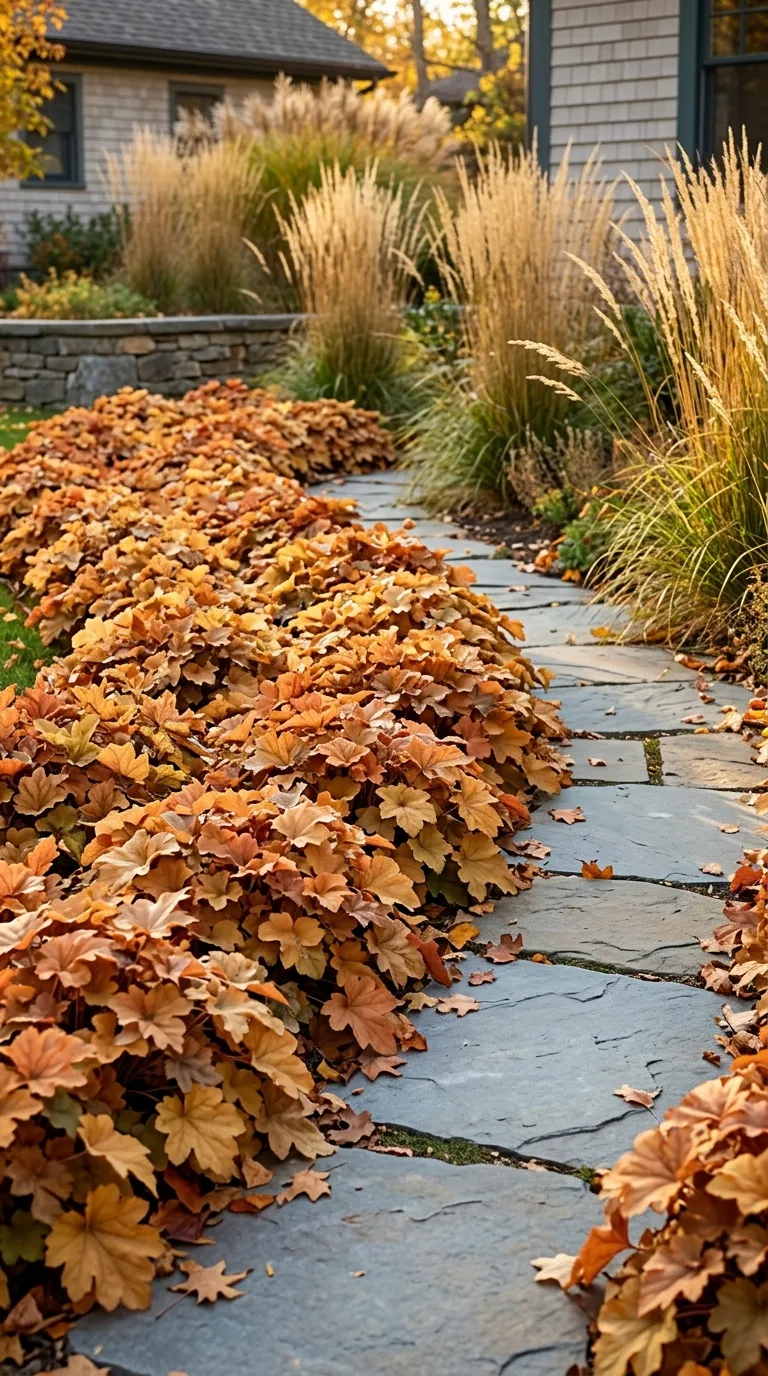
Amber and caramel heucheras bring warm color that suits wood mulch, flagstone and brick. ‘Caramel’ has apricot-to-golden leaves, and ‘Southern Comfort’ changes from peach to amber as its leaves mature; both are rated for zones 4 to 8. Plant them in broad drifts and combine them with ornamental grasses, whose tan and gold fall color echoes the leaves.
Good to know: pale and warm-toned leaves scorch easily in strong sun, so give these types morning sun or bright shade, especially in hot climates.
10. Heuchera Rock Garden Integration
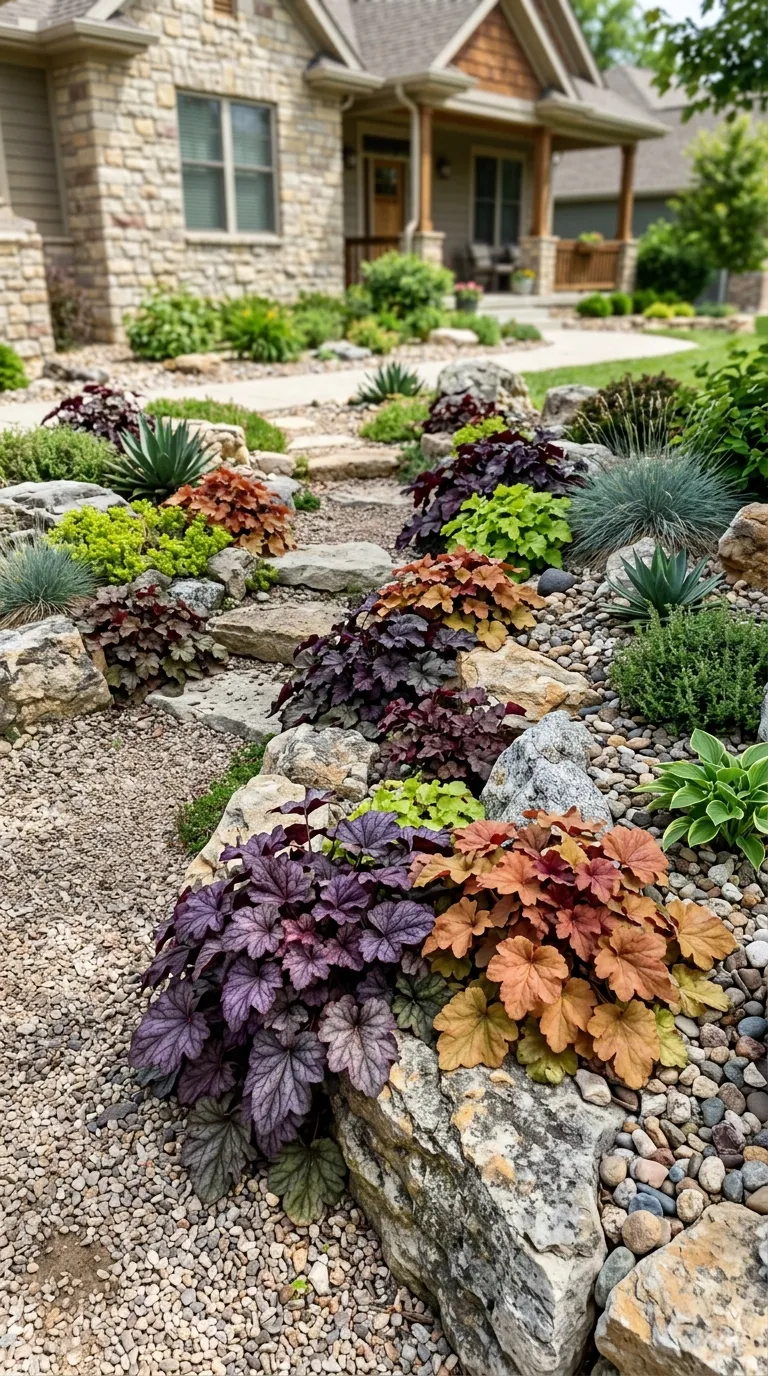
Heuchera tucked between rocks adds color and softens stone, and a rock garden’s fast drainage suits a plant that rots in wet soil. Use compact varieties in small pockets, set each crown at the soil surface rather than burying it, and let the leaves drape over the stone edges.
Good to know: rocks hold heat and pockets of soil dry out quickly, so choose spots with afternoon shade and water during dry spells.
11. Heuchera Under a Front Yard Mailbox
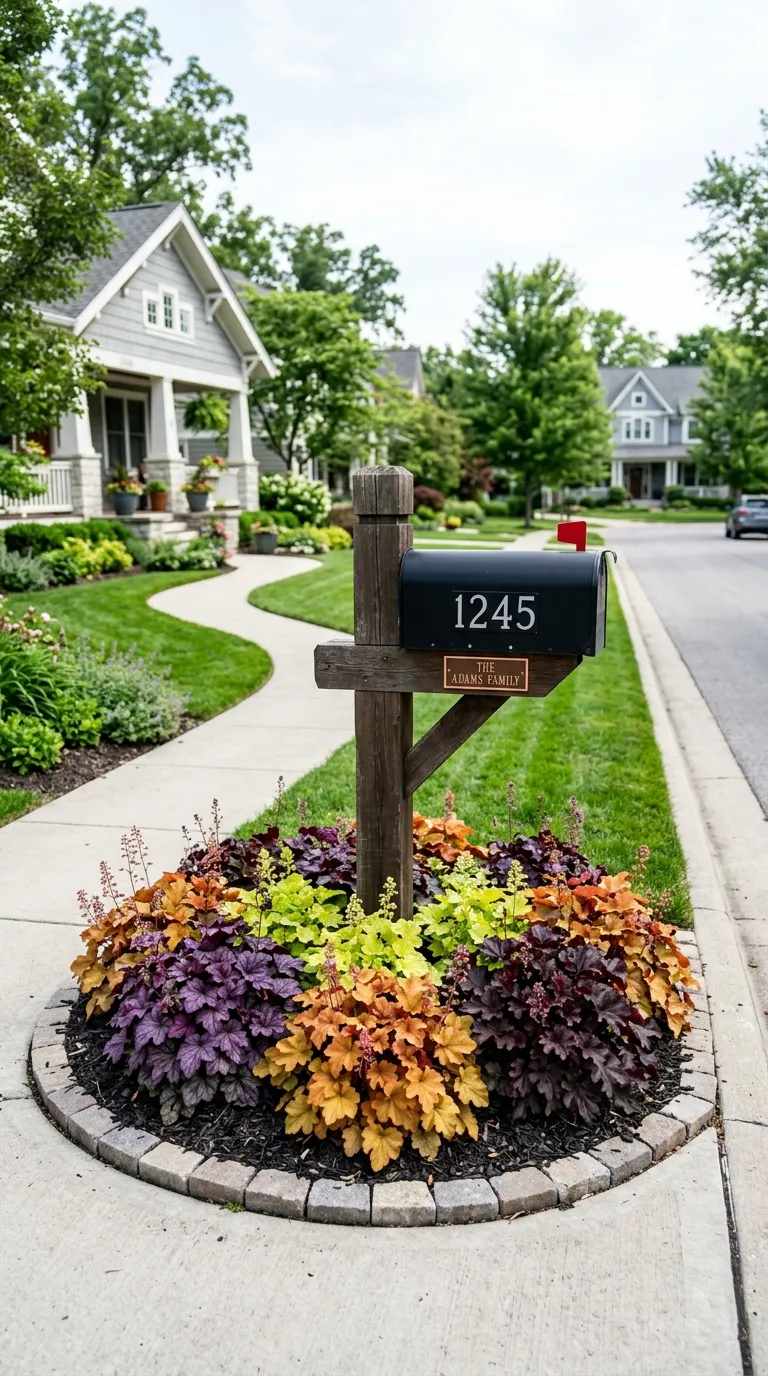
A small ring of heuchera around the mailbox post makes a tidy feature at the street. Use three to five plants in two or three colors, and keep them low and clear of the box so the carrier can reach it. Check the light: the post itself casts almost no shade, so a mailbox in full sun needs a dark, sun-tolerant variety and regular watering.
Good to know: in snowy areas, plants by the street take road salt and piled snow from plows, so plant on the side of the post away from the road.
12. Heuchera and Ornamental Grass Pairing
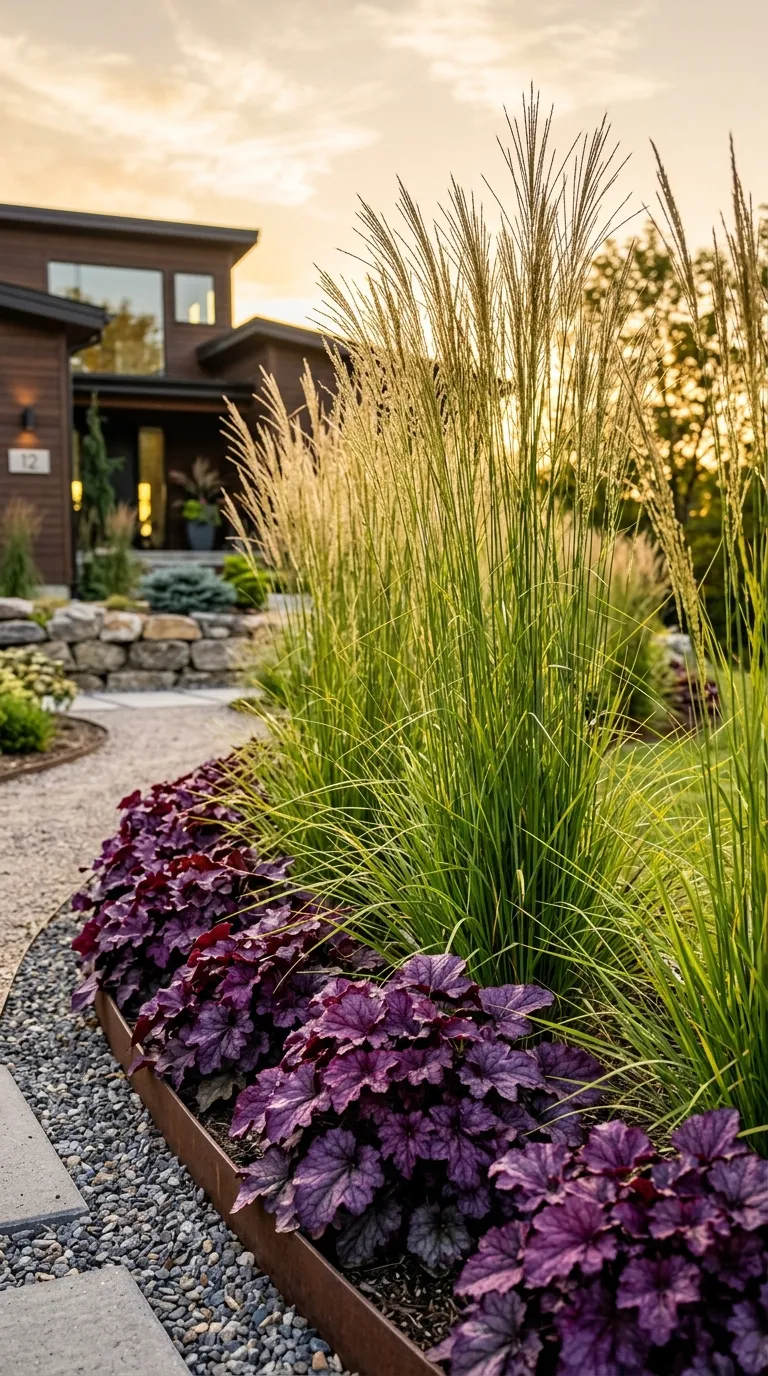
Heuchera’s broad, rounded leaves contrast with the fine, upright blades of ornamental grasses, so each makes the other stand out. Karl Foerster feather reed grass grows 3 to 5 feet tall but only 1 to 1.5 feet wide, leaving room for heuchera at its feet. The grass tends to flop in shade, so this pairing needs sun, which means choosing dark-leaved, sun-tolerant heuchera.
Good to know: cut the feather reed grass back in early spring, leaving about a third of its height as NC State Extension advises, and tidy tired heuchera leaves at the same time.
13. Heuchera Pathway Light Planting
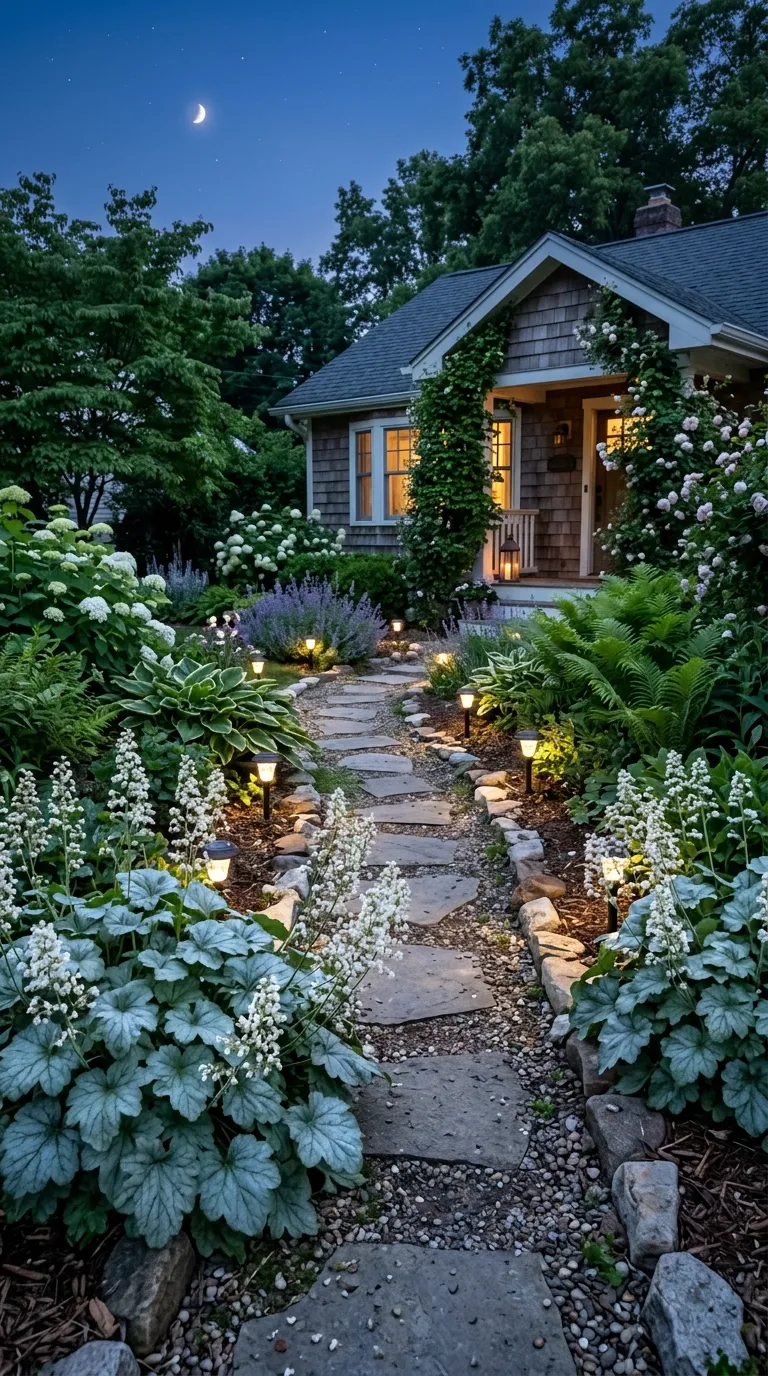
Planting heuchera around low path lights hides the stakes and wiring and gives each light a colorful base. Light-colored leaves, such as the ruffled lime ‘Lime Marmalade’ (8 to 10 inches tall), reflect more light at night than dark ones. ‘Gold Zebra’, often sold with heucheras, is actually a Heucherella, a cross between heuchera and foamflower.
Good to know: keep plants a few inches from each fixture so foliage doesn’t cover the light, and mark cable runs before planting so a trowel doesn’t cut them.
14. All Green Heuchera for a Modern Minimalist Look
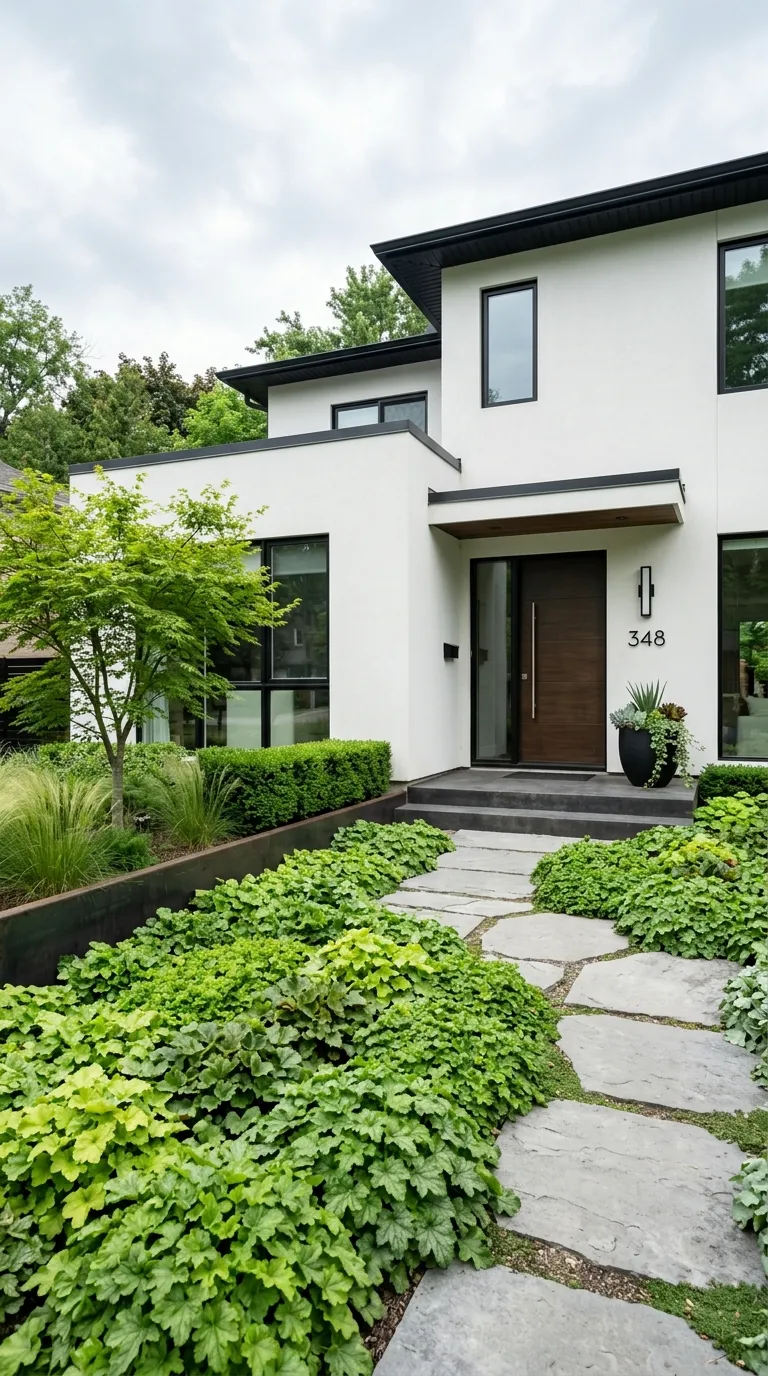
A block of one cultivar gives a calm, modern look that depends on leaf shape and texture instead of color contrast, and it suits white or gray houses with simple lines. Choose carefully, as some ‘green’ heucheras aren’t: ‘Green Spice’ has dark purple veins and turns amber in fall, and ‘Paris’ has silver-marked leaves and plentiful pink flowers. For solid color, use a lime cultivar such as ‘Lime Rickey’.
Good to know: when a plant dies or needs dividing, replace it with the same cultivar so the block stays uniform.
15. Heuchera Window Box Display
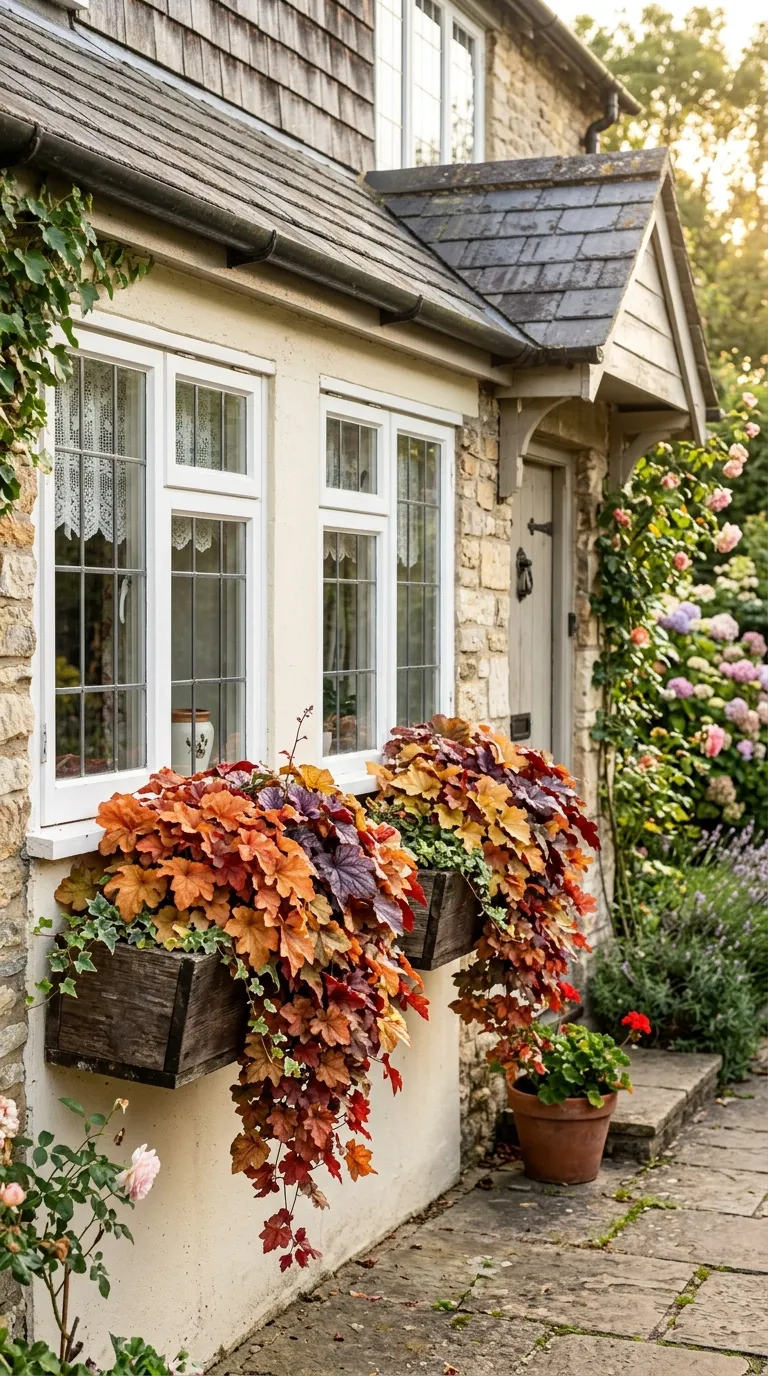
Heuchera works in window boxes in partial shade, and unlike annuals it can stay through winter in mild climates. Heucheras form mounds rather than trailing, so pair them with a trailing plant to spill over the front. Choose leaf colors that work with the window trim, and use a free-draining potting mix in a box with drainage holes.
Good to know: skip creeping Jenny as the trailing partner: NC State Extension notes it spreads aggressively and is considered an invasive weed in some areas. Trailing lobelia is an option in cool-summer climates.
16. Heuchera as Lawn Replacement in Small Areas
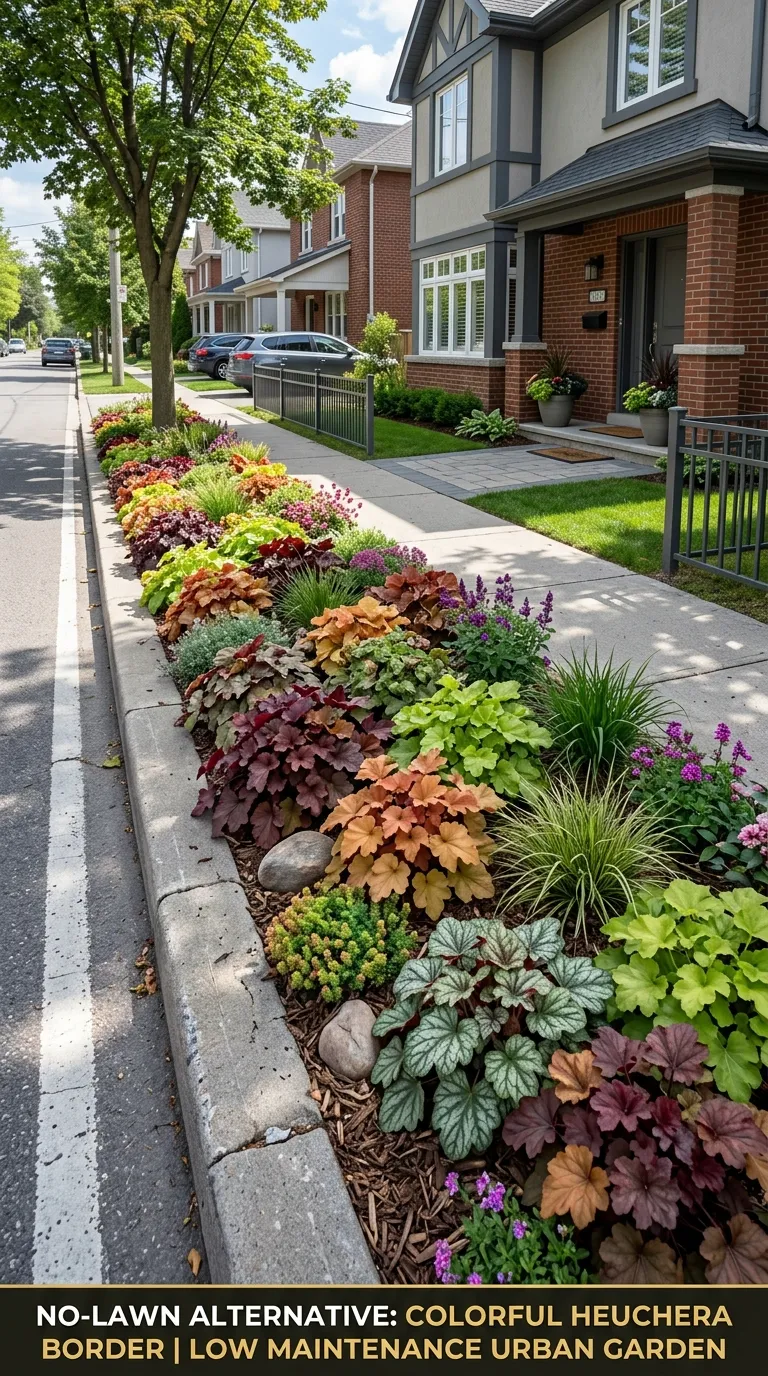
Heuchera can replace a small patch of struggling lawn in shade, such as a strip beside the walk where grass thins. Remove the grass, work compost into the soil, and plant at the mature width on the tag, usually 12 to 18 inches apart, so the mounds touch as they grow. For larger areas, see these grass-free front yard ideas.
Good to know: heuchera can’t be walked on like grass, so add stepping stones if people cut across the area, and weed between plants until they fill in.
17. Heuchera Spiral Pattern in a Circular Bed
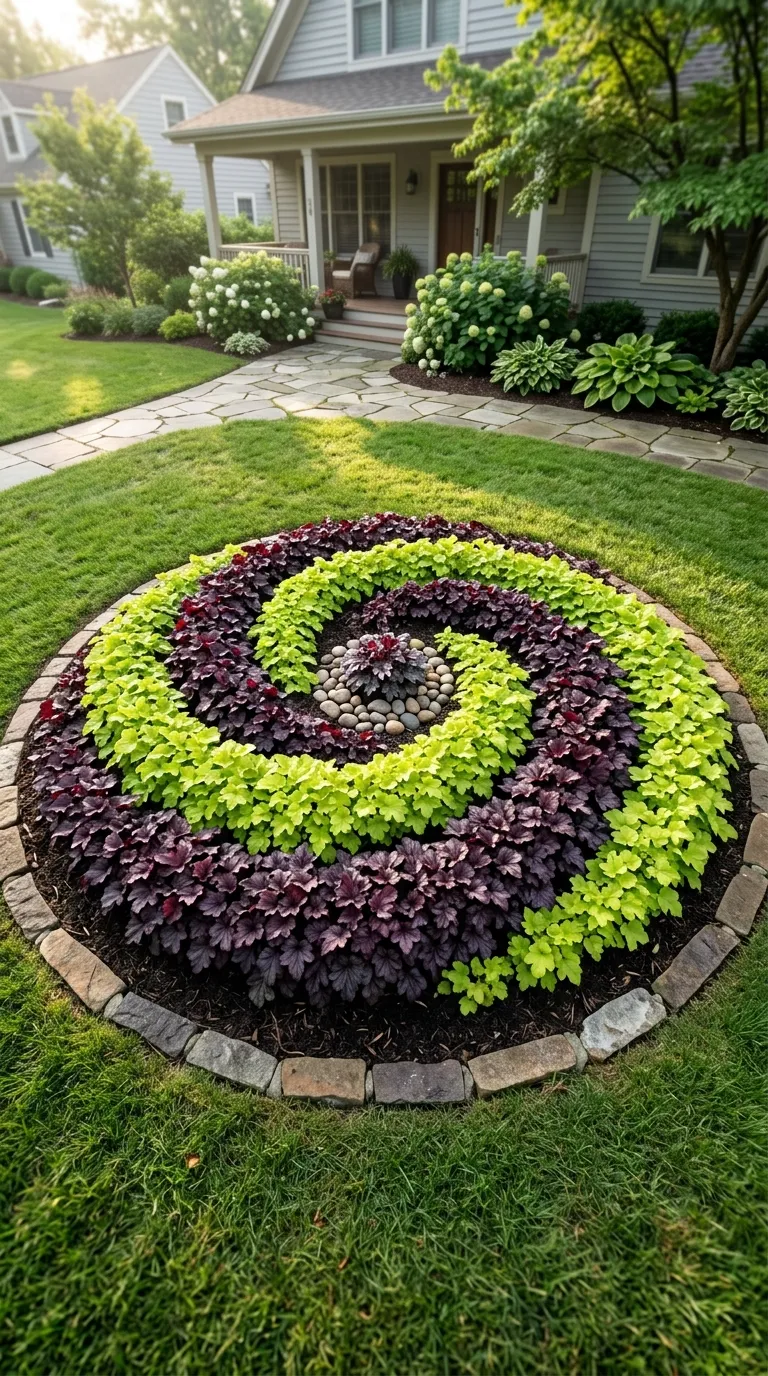
A spiral of two contrasting heucheras in a round bed makes a bold pattern that reads clearly from the street. Pair a near-black variety such as ‘Obsidian’ with a lime one such as ‘Lime Rickey’ for the strongest contrast. Mark the spiral with a garden hose or marking paint before planting so the curves stay smooth, and plant each arm as a single row.
Good to know: choose two cultivars of similar size and vigor, and when you divide clumps every 3 or 4 years, replant to the same pattern.
18. Heuchera Border Around a Front Yard Water Feature
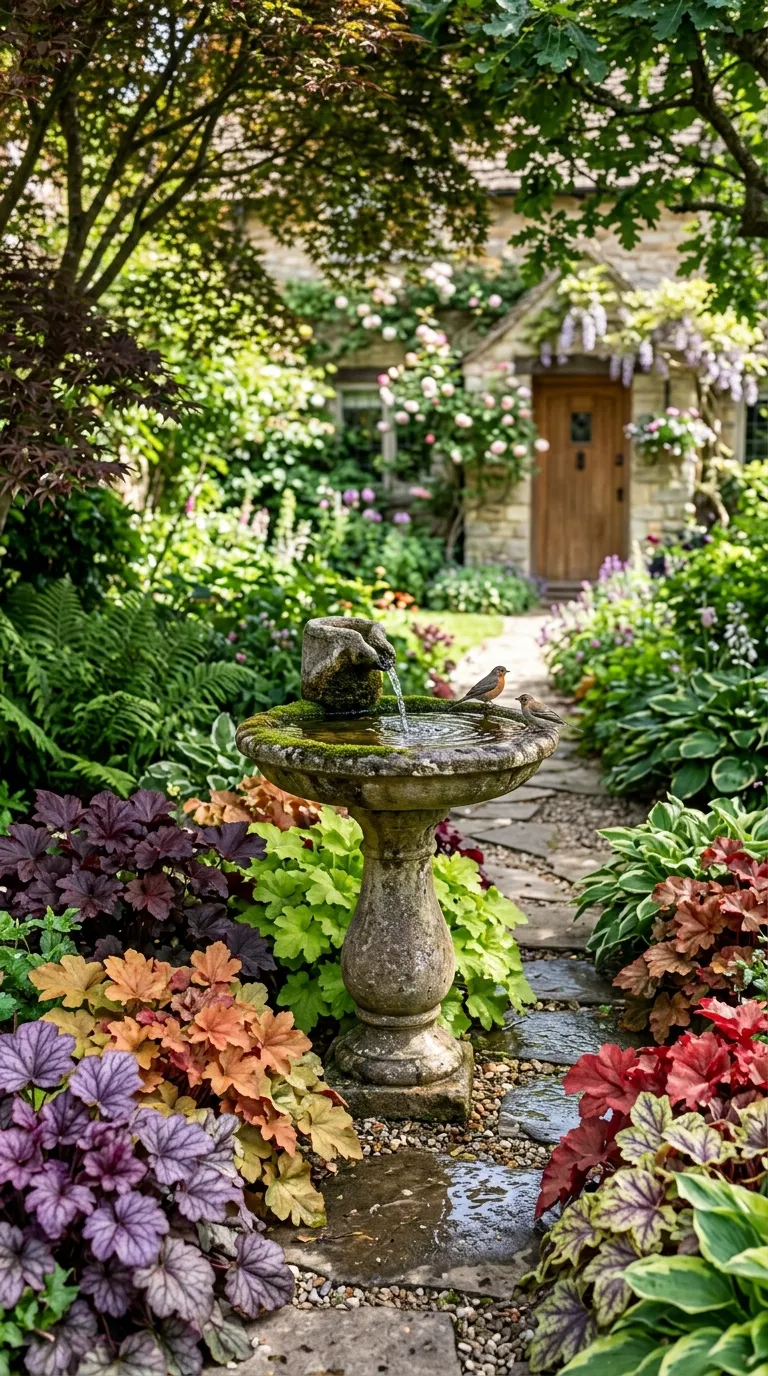
Heuchera around the base of a fountain or birdbath softens the hard edge and ties the feature into the bed. Plant just outside the splash zone: heuchera wants moist but well-drained soil, and ground that stays soaked from overflow will rot the crowns. Still water reflects foliage, so put the brightest leaves where the reflection shows from the house or path.
Good to know: if the ground right around the feature stays wet, use plants that like wet soil there and keep heuchera to the drier outer edge.
19. Heuchera Color Gradient Planting
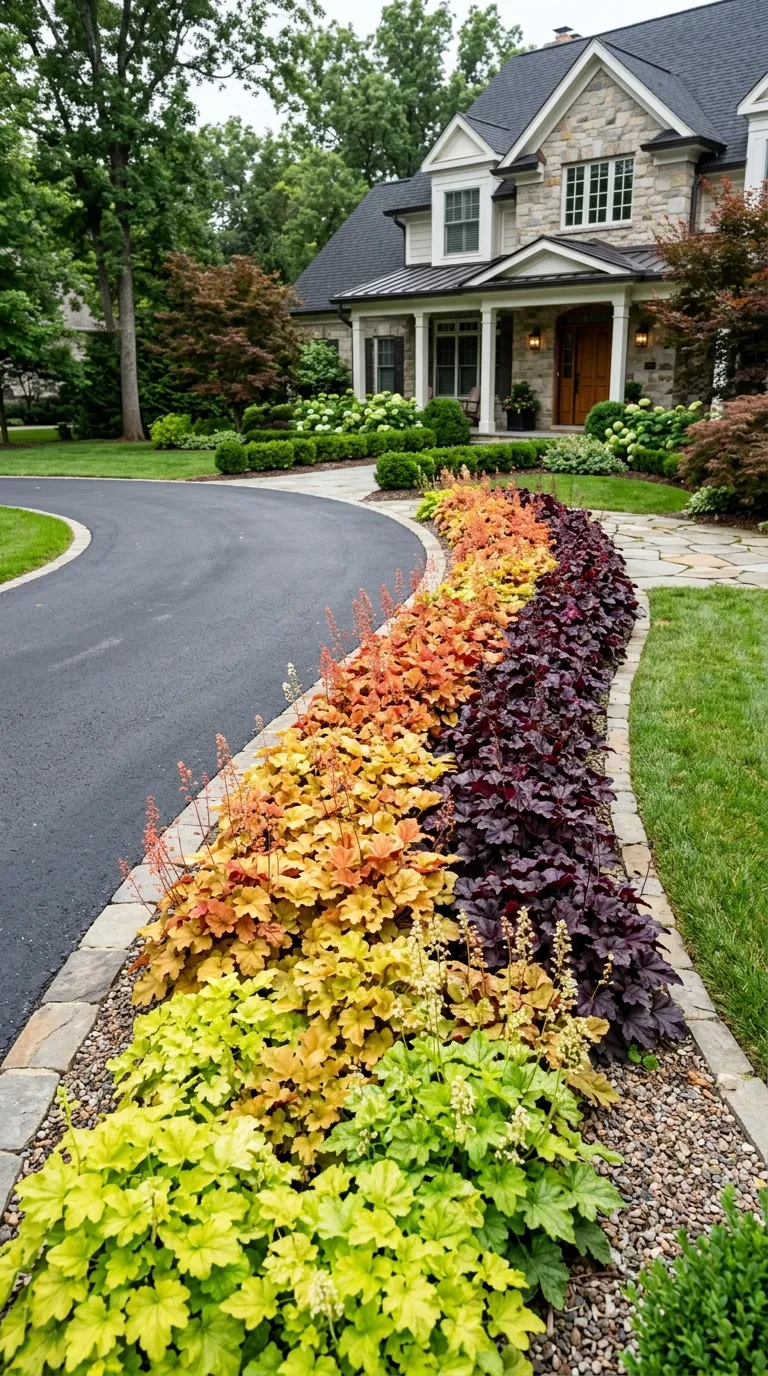
An ombre planting runs from lime through amber and copper to deep purple along a long bed, such as one beside the driveway or a property line. Use blocks of three to five plants of each color so the shift reads from a distance, and choose cultivars of similar mature size so one color doesn’t crowd out the next.
Good to know: if the bed has mixed light, put the dark types in the sunniest stretch and the lime and amber types where it’s shadiest, since pale leaves scorch first.
20. Heuchera in Hypertufa or Stone Troughs
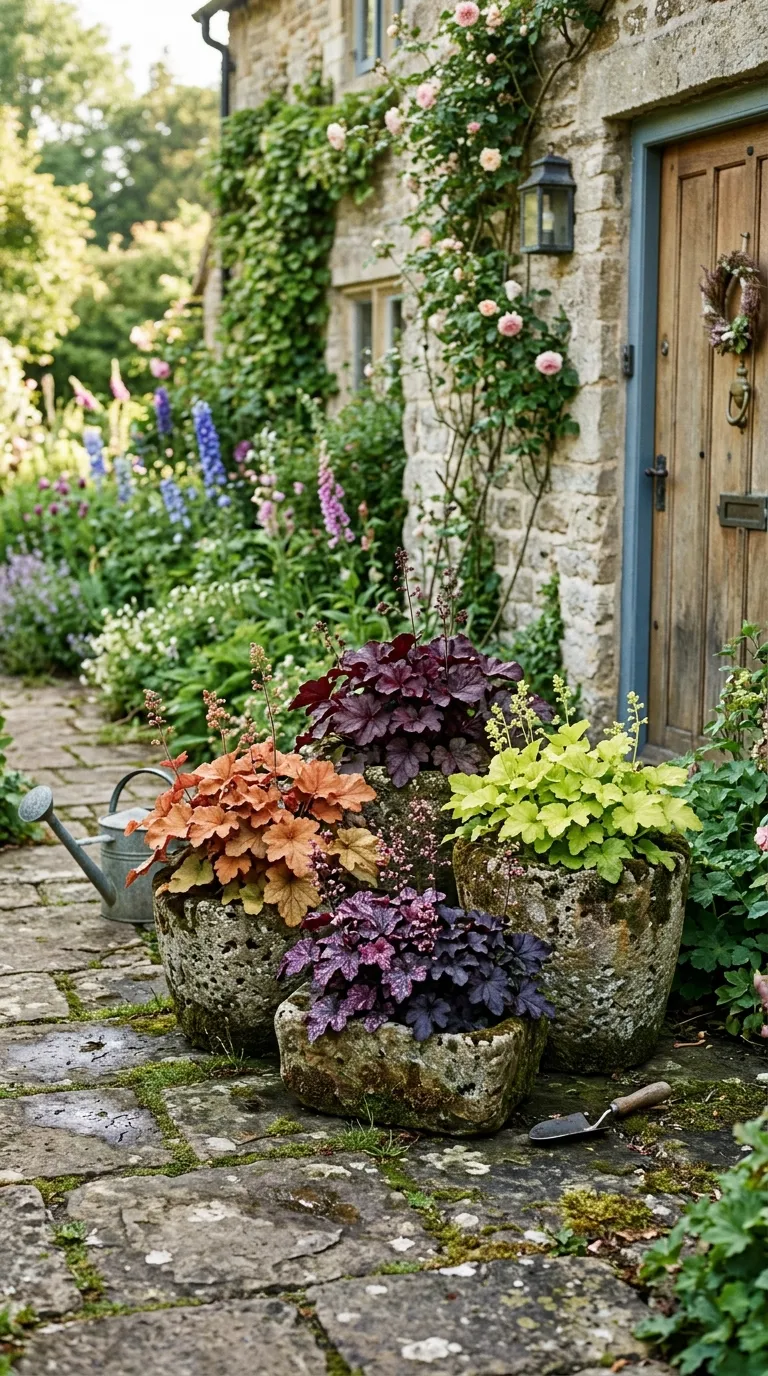
Hypertufa is a lightweight, stone-like mix of portland cement, peat moss and perlite that can be cast into rustic troughs. Two or three troughs of different sizes grouped by the entrance, each with a different heuchera, let visitors see the leaf patterns up close. Make sure each trough has drainage holes and use a gritty, free-draining potting mix.
Good to know: wear gloves and a dust mask when mixing hypertufa, since cement and perlite dust irritate skin and lungs, and let a new trough cure fully before planting.
21. Heuchera Under Front Yard Rose Bushes
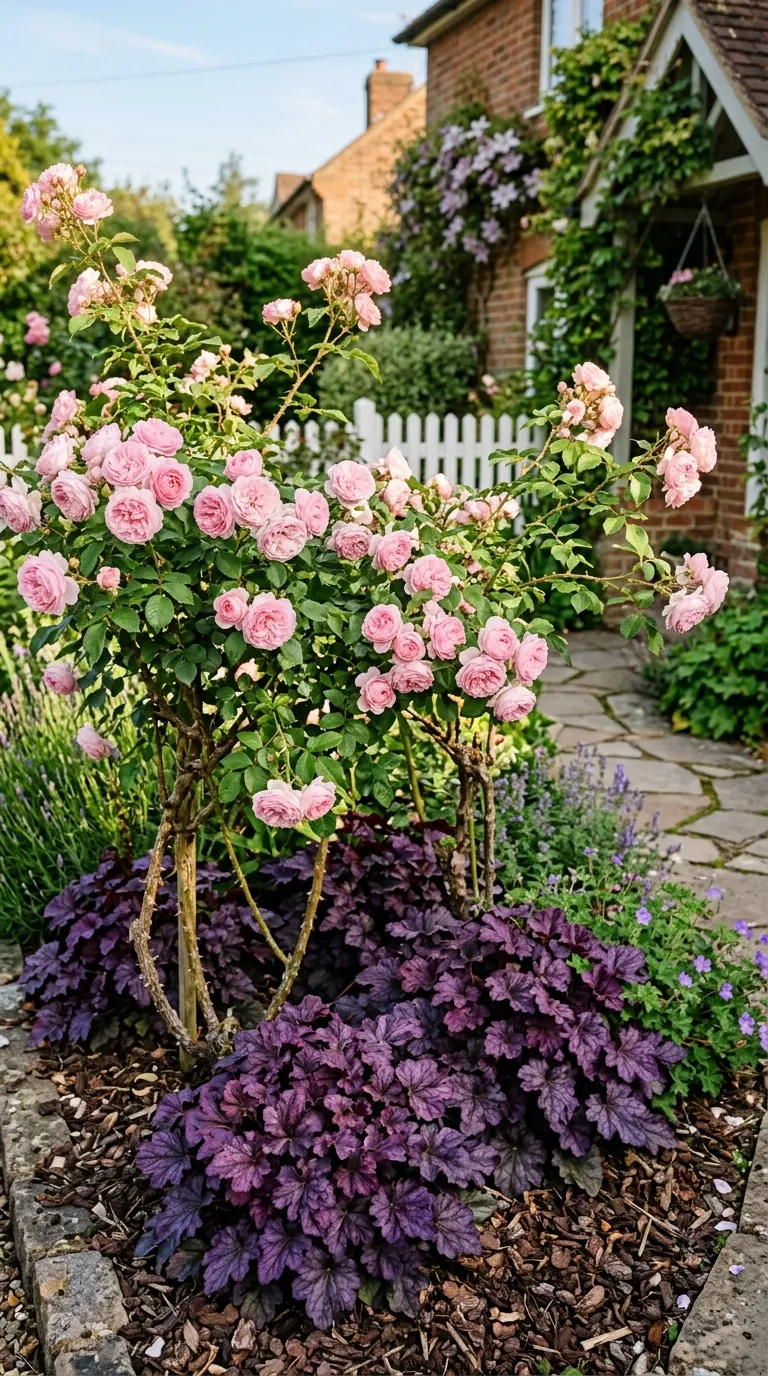
Heuchera at the base of rose bushes hides bare lower canes and adds a second layer of color. Roses need at least six hours of direct sun, so use dark-leaved heucheras that tolerate sun, and keep them a little back from the canes. Silver heuchera under pink roses, or deep purple under yellow or white ones, gives good contrast.
Good to know: University of Maryland Extension advises spacing roses for good air movement to help prevent disease, so don’t let heuchera crowd the base of the canes.
22. Seasonal Interest Heuchera Combination

Many heucheras change color through the year, so a mix can look different in spring, summer and fall. ‘Southern Comfort’ moves from peach to amber as its leaves mature, ‘Amber Waves’ is brightest in spring and darkens through the season, and ‘Green Spice’ turns amber in fall. Planting two or three such types together keeps the bed changing.
Good to know: in cold regions, leave the old leaves on over winter to protect the crown, as the RHS suggests, and tidy them in spring.
23. Heuchera Welcome Garden at the Property Entrance
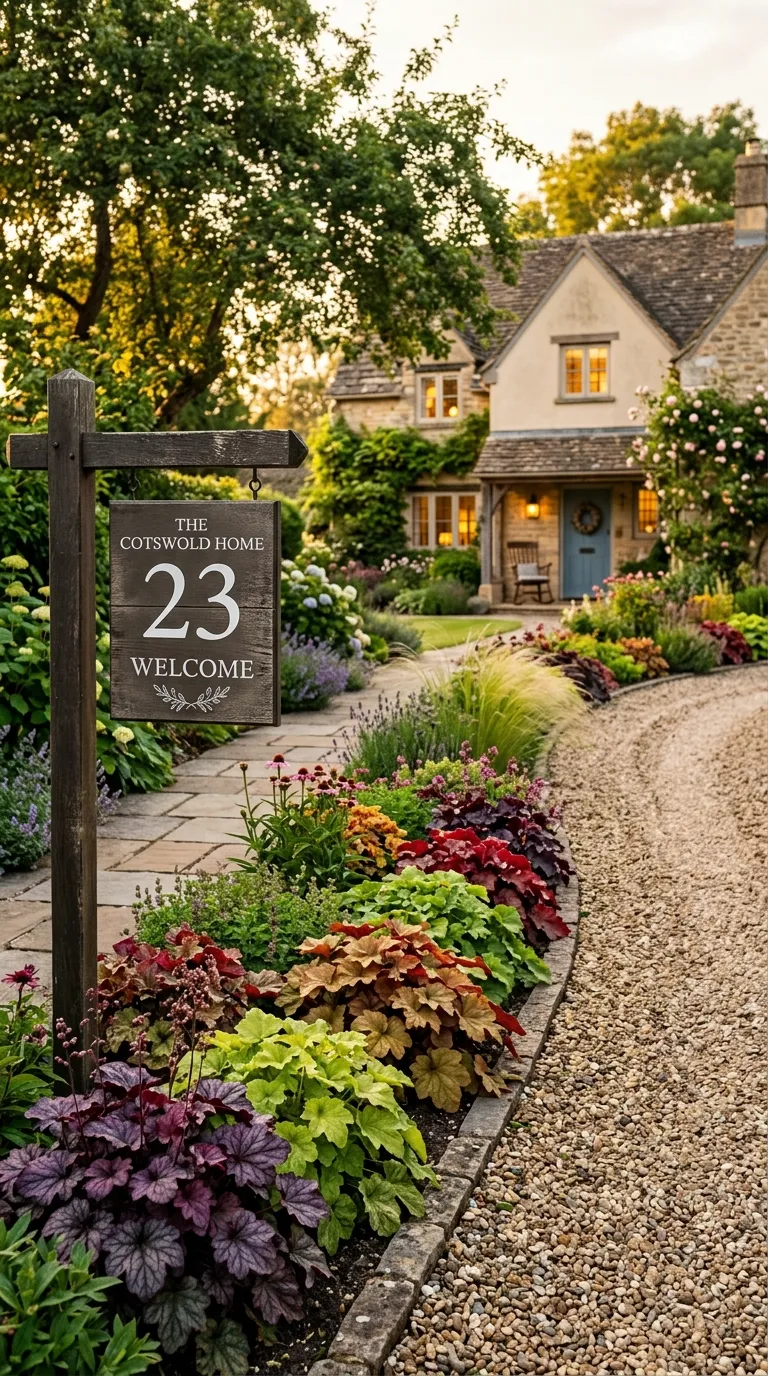
A small heuchera planting at the end of the driveway, beside a gate or at a fence opening marks the entrance to the property. Group three to five heuchera colors around a house-number post, add a few stones and one upright ornamental grass for height, and keep the bed small enough to water easily.
Good to know: keep plantings where the driveway meets the street low enough that drivers can see people and traffic; heuchera stays low, but a tall grass can block the view.
Common mistakes to avoid
- Planting in soggy soil or heavy clay without improving drainage.
- Burying the crown; plant at the same level as in the pot, or slightly higher.
- Putting lime, gold or amber types in hot afternoon sun.
- Ignoring winter heaving; the RHS advises checking plants each spring and replanting any that have lifted.
- Never dividing, so plants turn woody and decline.
- Pairing heuchera with invasive creeping Jenny.
Heuchera FAQs
Does heuchera like sun or shade?
Most prefer partial or dappled shade. Dark-leaved types tolerate more sun, while pale leaves scorch in hot sun.
Is heuchera deer resistant?
NC State Extension lists it as deer and rabbit resistant because of tannins in the leaves, though hungry deer may still browse.
Is heuchera safe for pets?
The ASPCA lists coral bells (Heuchera sanguinea) as non-toxic to dogs, cats and horses. Hostas, a common companion, are toxic to pets.
Why did my heuchera die after a few years?
Usually wet soil, a buried crown or age. Plants get woody in the center and are short-lived unless divided every 3 or 4 years.


One Comment